English
 Japanese

Filming studio and cast research costs reduced by 60%. Video production companies are increasingly utilizing AI.
TVC Co., Ltd.


Issues before implementation
Effects after implementation
table of contents
TVC Co., Ltd. conducted a generative AI training program called "Corporate Reskilling" for 12 participants over a period of approximately six months. The 33 actual work tasks registered by the participants resulted in a total reduction of 2,031 minutes (approximately 34 hours) per month. The frequency of AI use also nearly doubled, from 2.2 days per week to 4.0 days per week.
From using AI only about two days a week, with individual usage varying, to integrating it into research, planning, and document creation—this is how an advertising company specializing in video production, including TV commercials, expanded its use of AI over the past six months.
Company Introduction

TVC Co., Ltd. is an advertising company headquartered in Shibuya-ku, Tokyo. Established in 1980, it has 80 employees (as of March 2025). With video production as its core business, it handles all aspects of advertising, from TV commercials and digital advertising to outdoor advertising.

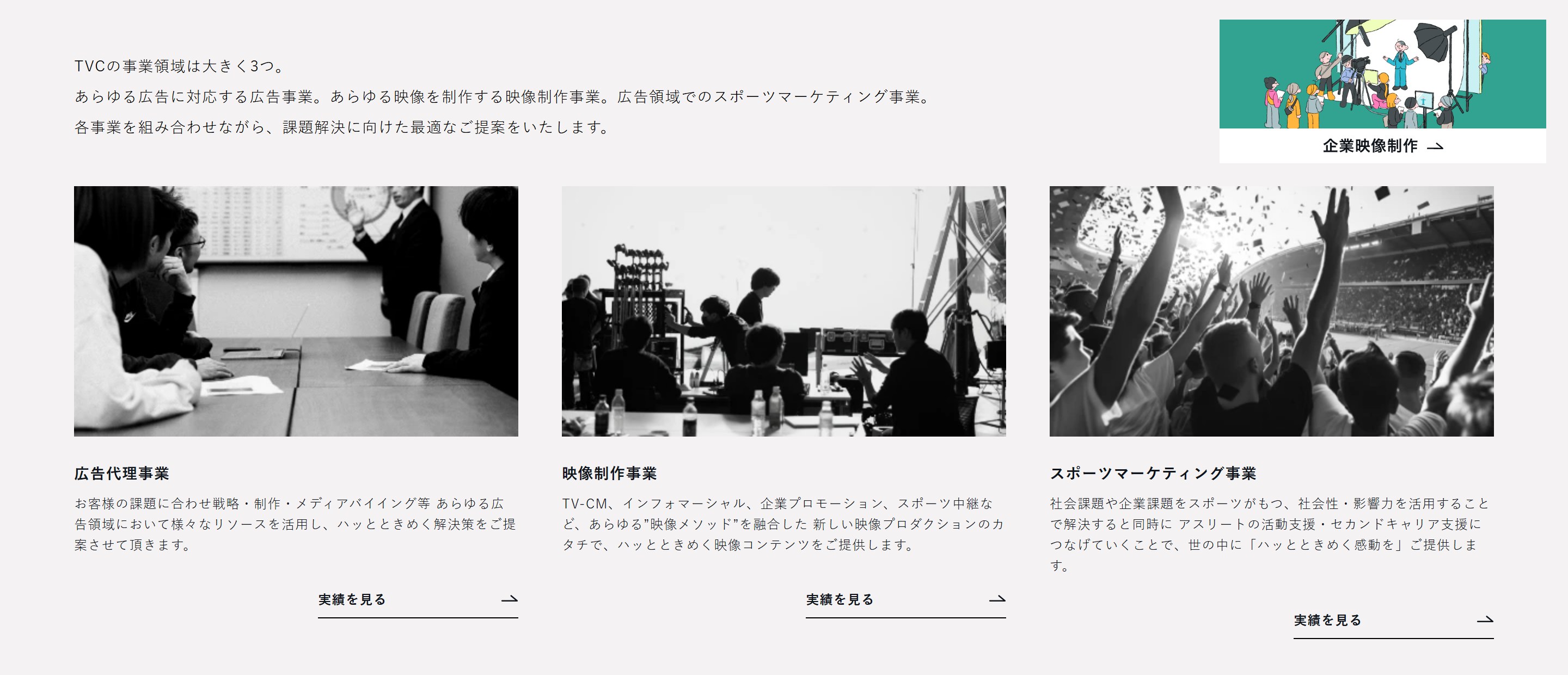
The business isAdvertising agency business, video production business, sports marketing businessThese are the three main areas. In video production, we handle everything from TV commercials and infomercials to corporate promotions and sports broadcasts. Our strength lies in our ability to complete everything in-house, from planning and production to editing and delivery. Our clients come from a wide range of industries, including healthcare, logistics, daily necessities, finance, education, and transportation.
The vision the company has put forward is"VISION2030: An advertising company that allows you to enjoy various things with various people."This reflects our belief that, in order to address all areas of the advertising industry, we value connections not only with our employees but also with our clients and partners, and that everyone involved enjoys their work, which leads to problem-solving.
Issues before introducing generative AI
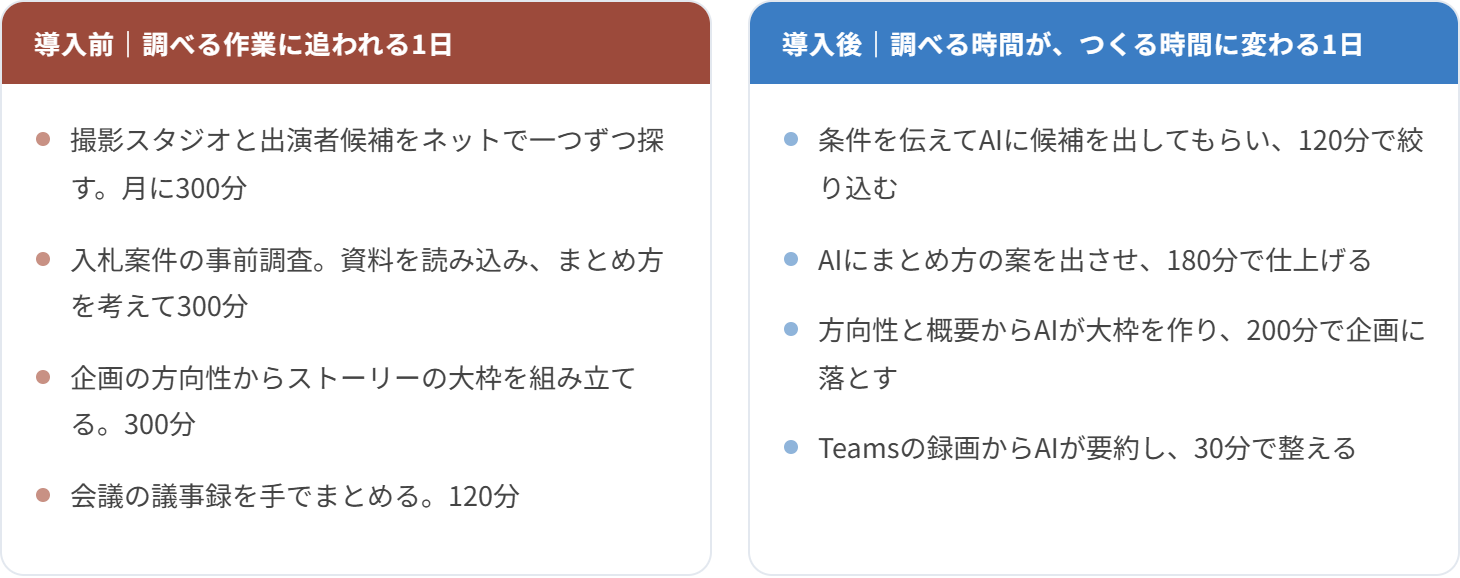
In video production, a lot of research is required before filming begins. This includes finding filming studios and locations, potential actors, and preparing snacks and lunches for the shoot. Even at the planning stage, it's necessary to build the overall storyline based on the direction and outline.
In a survey conducted at the start of the training, participants reported using AI in an average of 2.0 tasks per week. According to feedback sheets, the average frequency of AI use before the training was 2.2 days per week. This means that participants were not using AI for more than half of the week, and the situations in which they used it varied greatly from person to person. Some participants also expressed concerns about not having a clear standard for judging how much they could trust the AI's output.
The workload was also reflected in the numbers. Researching filming studios and potential actors, conducting preliminary investigations for bidding projects, and creating storylines for projects each took 300 minutes per month. Creating workflows took 480 minutes per month. Administrative tasks such as taking meeting minutes and checking contracts each took 120 minutes per month.
Implementation details - TVC's unique initiatives
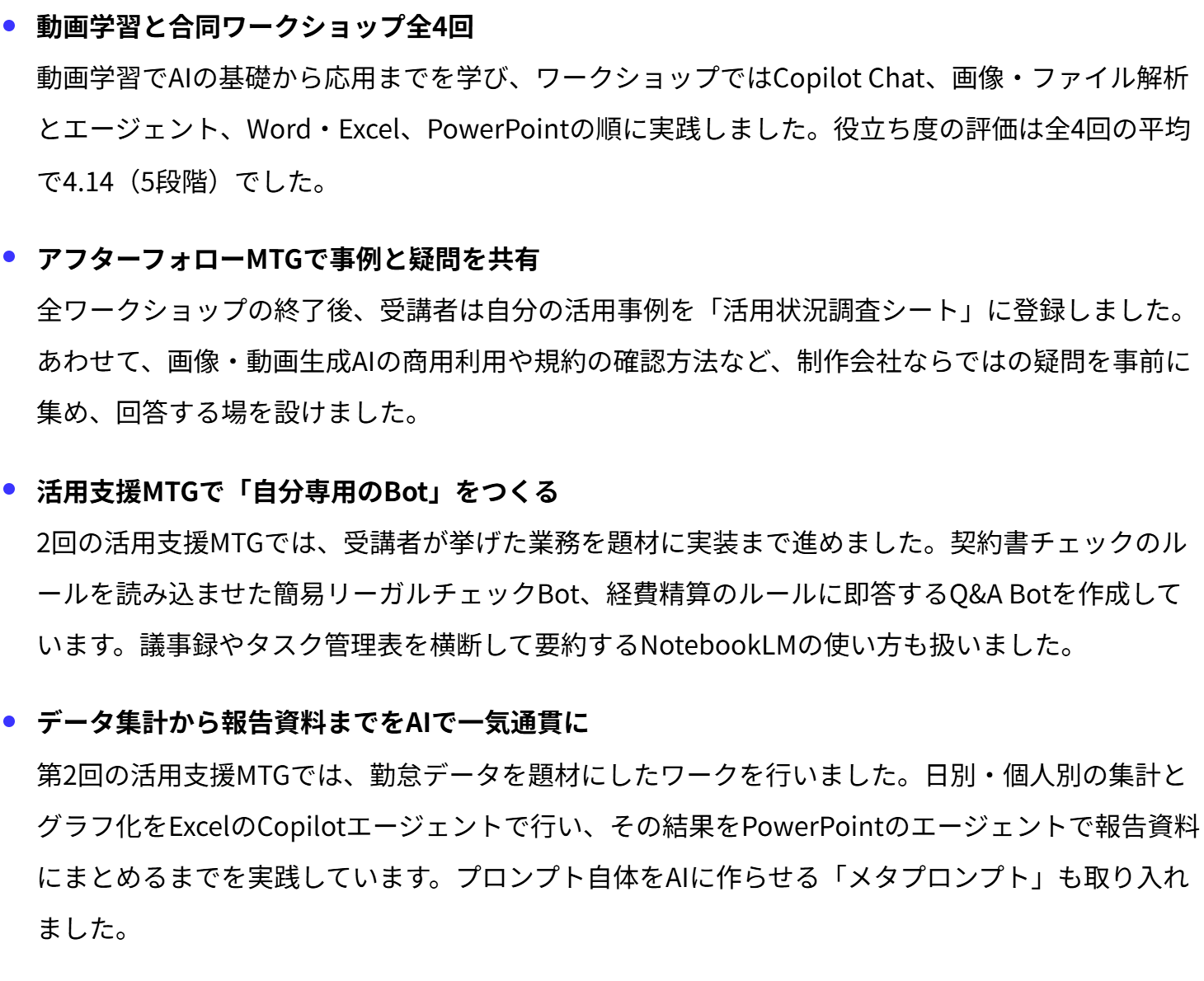
The six-month program is designed to allow participants to seamlessly transition between learning and practical work, with Microsoft Copilot as its core tool.
Benefits of using generative AI
The first noticeable change, typical of a video production company, was in the research involved in preparing for filming. Instead of manually searching for filming studios and potential actors online, they switched to a system where they provide criteria and an AI generates candidates. As a result, the research time, which used to be 300 minutes per month, has been reduced to 120 minutes.
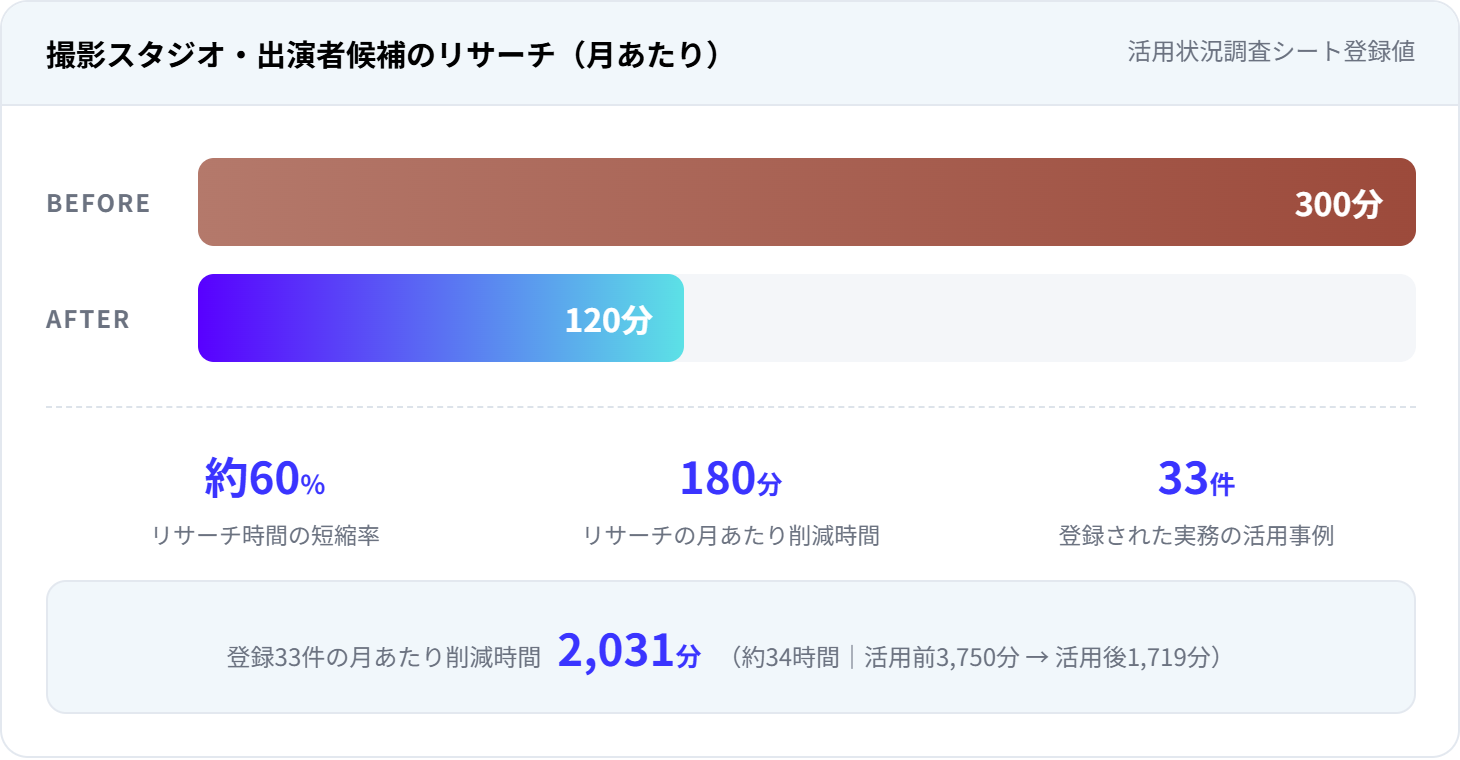
When we compiled the 33 actual work tasks registered by the participants,A total reduction of 2,031 minutes (approximately 34 hours) per month.This means that the work that previously took 3,750 minutes per month has been reduced to 1,719 minutes. Looking at it on a per-task basis, the work time has been reduced by 60% or more for 14 out of 33 tasks.
The indicators themselves are also changing.

Looking at the flow of events over the course of a day, the changes are as follows:
Before/After by Task (Top 5 Tasks with Reduced Time)
| business | Before | After | reduction/month |
|---|---|---|---|
| Power Automate Flow Creator | 480 minutes | 120 minutes | 360 minutes |
| Research on filming studios and potential actors | 300 minutes | 120 minutes | 180 minutes |
| Preliminary investigation of bidding projects | 300 minutes | 180 minutes | 120 minutes |
| Story creation for the project | 300 minutes | 200 minutes | 100 minutes |
| Summary of Terms of Use for Video Generation AI | 120 minutes | half an hour | 90 minutes |
At the top of the list are the pre-production processes of research and planning. Even in creating workflows, using AI to generate workflow proposals and check for errors reduced the time from 480 minutes to 120 minutes. Summarizing the terms of use for the video generation AI (120 minutes → 30 minutes) is a task unique to this company, which is trying to incorporate generation AI into its production. Meeting minutes have also been shortened from 120 minutes to 30 minutes by summarizing them from Teams recordings.

These changes are also reflected in the participants' feedback.

The process has shifted from simply using AI without a clear purpose to considering how to use it effectively to achieve results. Participants' understanding of how to handle AI output has also changed.

In response to the concern raised before the training about "how much can we trust it?", a clear distinction was made: the final decision rests with humans, while the preceding processes are entrusted to AI. As the training progressed, more and more participants shared their positive experiences and feedback on its practical applications.

Future outlook
Now that results are starting to show, TVC's next goal is to move from a state where AI is "used by those who want to use it" to a state where it is "integrated into the workflow."
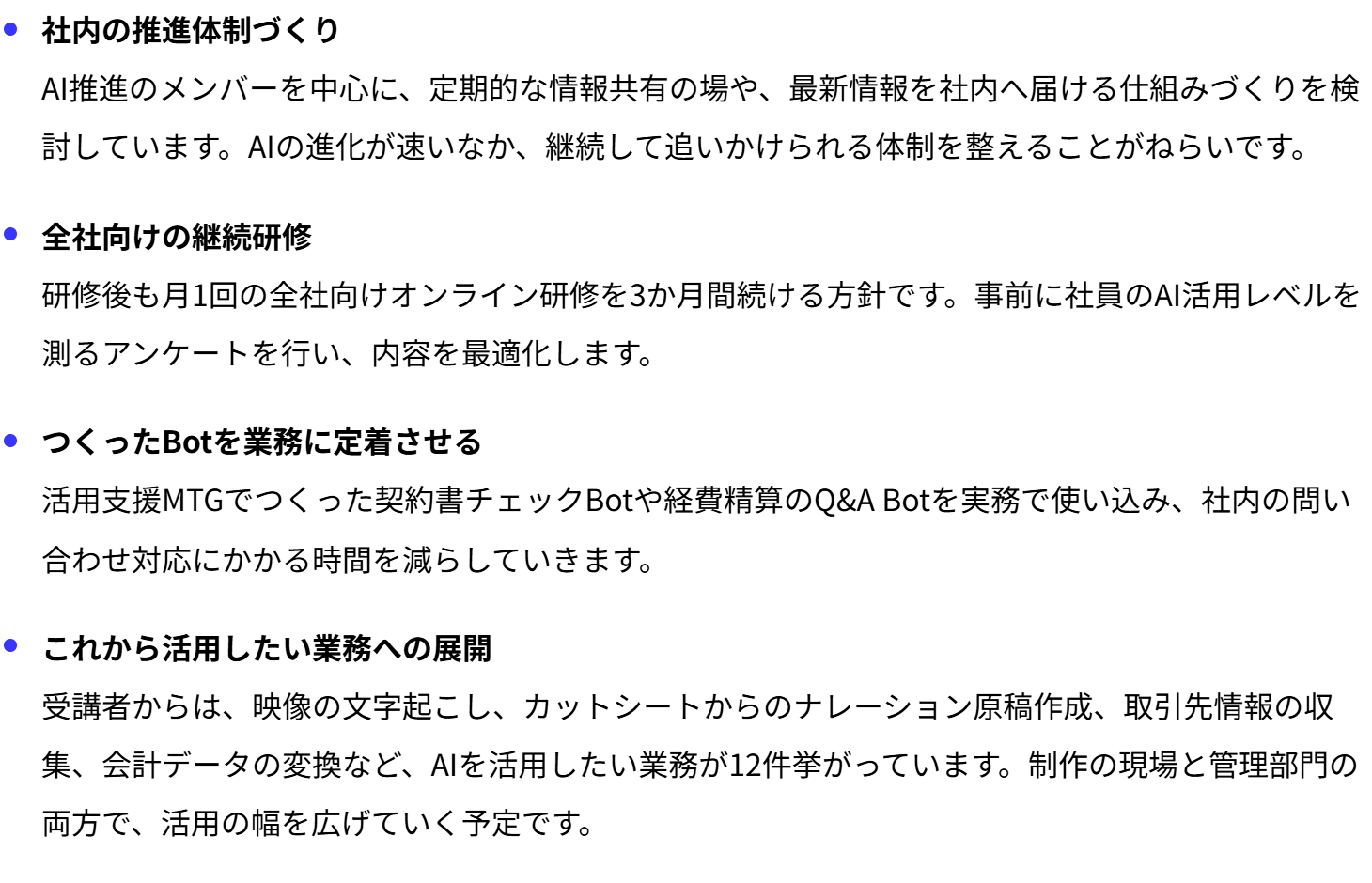
TVC has incorporated AI into 33 projects in the past six months. By shortening the research and planning stages, they are beginning to have more time to focus on the production itself.
"An advertising company where you can enjoy all kinds of things with all kinds of people." The participant's comment, "I'm starting to have fun," aligns with the company's vision for VISION 2030. With the addition of a new tool—generative AI—the company's progress will continue to expand.