English
 Japanese

Weekly time savings increased by approximately 451 TP3T. A real estate company that revitalizes older buildings expanded its use of AI over six months with 33 employees.
Realgate Co., Ltd.


Issues before implementation
- Email handling: Some people were creating and checking as many as 300 emails a week, one by one, and this was taking up a lot of time each day regardless of their job title.
- Concentration of specialized tasks: Checking drawing regulations took 120 minutes per session, and estimating construction costs took 180 minutes. Heavy verification work was concentrated on a limited number of personnel with specialized knowledge.
- Sharing AI utilization: Some people were able to use AI effectively on their own, while others were not, and usage methods were not shared within the company. The average number of AI-utilized tasks in the first training session was 2.34.
Effects after implementation
- Email support: 26 tasks (22 people) involving email creation and confirmation, reduced from 29,920 minutes per month to 16,800 minutes. This represents a reduction of 13,120 minutes (approximately 219 hours) per month using AI.
- Focus on specialized tasks: Drawing and legal compliance checks reduced from 120 minutes to 60 minutes, rough cost estimation from 180 minutes to 90 minutes, and new construction method research from 120 minutes to 60 minutes. The number of tasks using Gem and NotebookLM also increased to 21.
- Sharing of AI utilization: The average number of tasks utilizing AI increased from 2.34 to 3.29 (an increase of approximately 401 TP3T), and the weekly time saved increased from 2.09 hours to 3.03 hours (an increase of approximately 451 TP3T). This trend continued throughout all four sessions.
table of contents
Realgate Co., Ltd. conducted a generative AI training program called "Corporate Reskilling" for 33 participants from sales, design, construction management, and administrative departments over a six-month period from January to June 2026. Through four workshops, the average number of tasks utilizing AI increased from 2.34 to 3.29, a rise of approximately 401 TP3T, and the time saved by AI increased from 2.09 hours per week to 3.03 hours, a rise of approximately 451 TP3T.
Simply by each individual using their own ingenuity, the company progressed from a state where usage methods weren't shared internally to a stage where Gemini, Gem, and NotebookLM are used selectively according to the task. We will introduce how this company, which handles the revitalization of old buildings, expanded its use of AI in just six months.
Company Introduction

Realgate Co., Ltd., established in 2009, is a real estate regeneration company headquartered in Shibuya-ku, Tokyo. They develop businesses that regenerate older buildings in central Tokyo into offices, retail spaces, hotels, and other facilities suitable for startups. The company is listed on the Tokyo Stock Exchange Growth Market (Securities Code: 5532).

The company's strength lies in its system of handling everything in-house, from property acquisition to planning, design, construction, leasing, and operation."Flexible Workplace Business"They are revitalizing underutilized real estate by adding value through seismic reinforcement and changes in use, transforming them into highly profitable properties that can serve as workplaces with various specifications. Buildings that are over 40 to 50 years old, such as "THE WORKS" built in 1969 and "SHIFT HOTEL SHIBUYA HATAGAYA" built in 1972, have also found new roles through their efforts.
The principles we uphold are"Giving value to old things, and creativity to real estate."Based on this philosophy, instead of demolishing and rebuilding buildings, we aim to continue using existing buildings for 100 years."100-Year City and Architecture Project"We are starting it up.
Issues before introducing generative AI
This company's business is driven by its sales team. The management team believed that raising and disseminating AI literacy throughout the entire company, not just in a few departments, would be key to maximizing business growth. Therefore, for this training program, they selected participants from approximately half of the sales staff, along with members from the design, construction management, and administration departments, to explore ways to streamline each individual task.
Although we were making daily improvements within the company, we hadn't yet reached the point of significantly changing our operations with AI and systems. Some employees were able to streamline their work, while others weren't, and these efforts weren't being shared. Customer service records, follow-ups, and vacancy management were all manually entered into spreadsheets, and compiling this data into reports for management was a time-consuming process.
In the initial training survey, participants reported using AI for an average of 2.34 tasks, and saving an average of 2.09 hours per week through AI. This indicates that while participants were exposed to AI, its use was limited to specific tasks such as writing emails and conducting research.
The most burdensome aspect of our work inventory was email handling, which occurs regardless of job type. Some people were handling as many as 300 emails a week. For specialists, checking drawings for compliance took 120 minutes per session, estimating construction costs took 180 minutes, and researching new construction methods took 120 minutes. Verification tasks requiring high-level judgment were concentrated on personnel with specialized knowledge.
Implementation details - A unique initiative by Realgate.
The six-month program was designed to start with company-wide fundamentals and then gradually progress to practical applications using the company's business data.
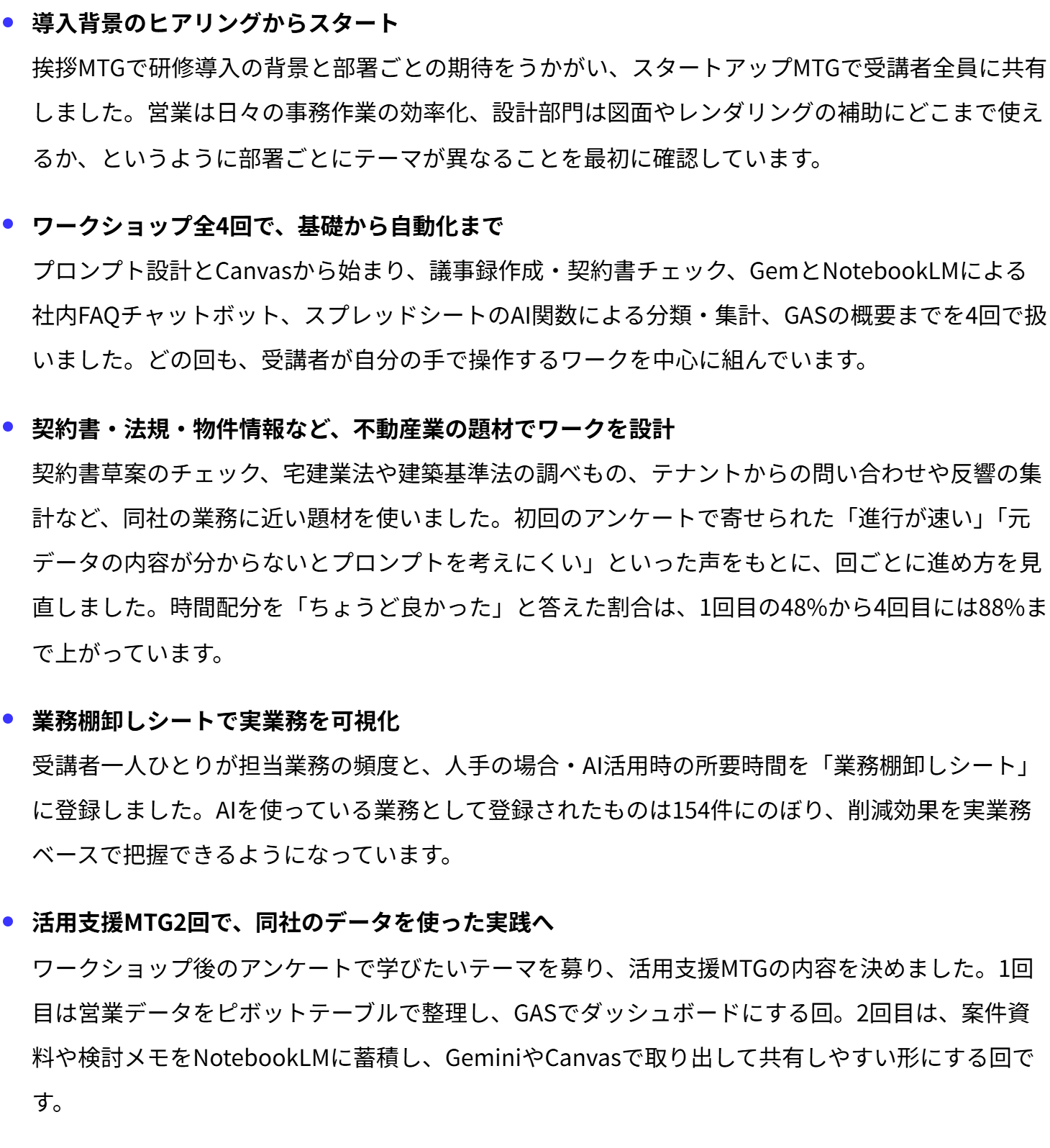
Benefits of using generative AI
One notable change in our specialized work is the legal compliance checks of construction management drawings. A check that previously took 120 minutes can now be completed in 60 minutes using AI. Even demanding tasks that were previously concentrated on specialists can now be handled in half the time.
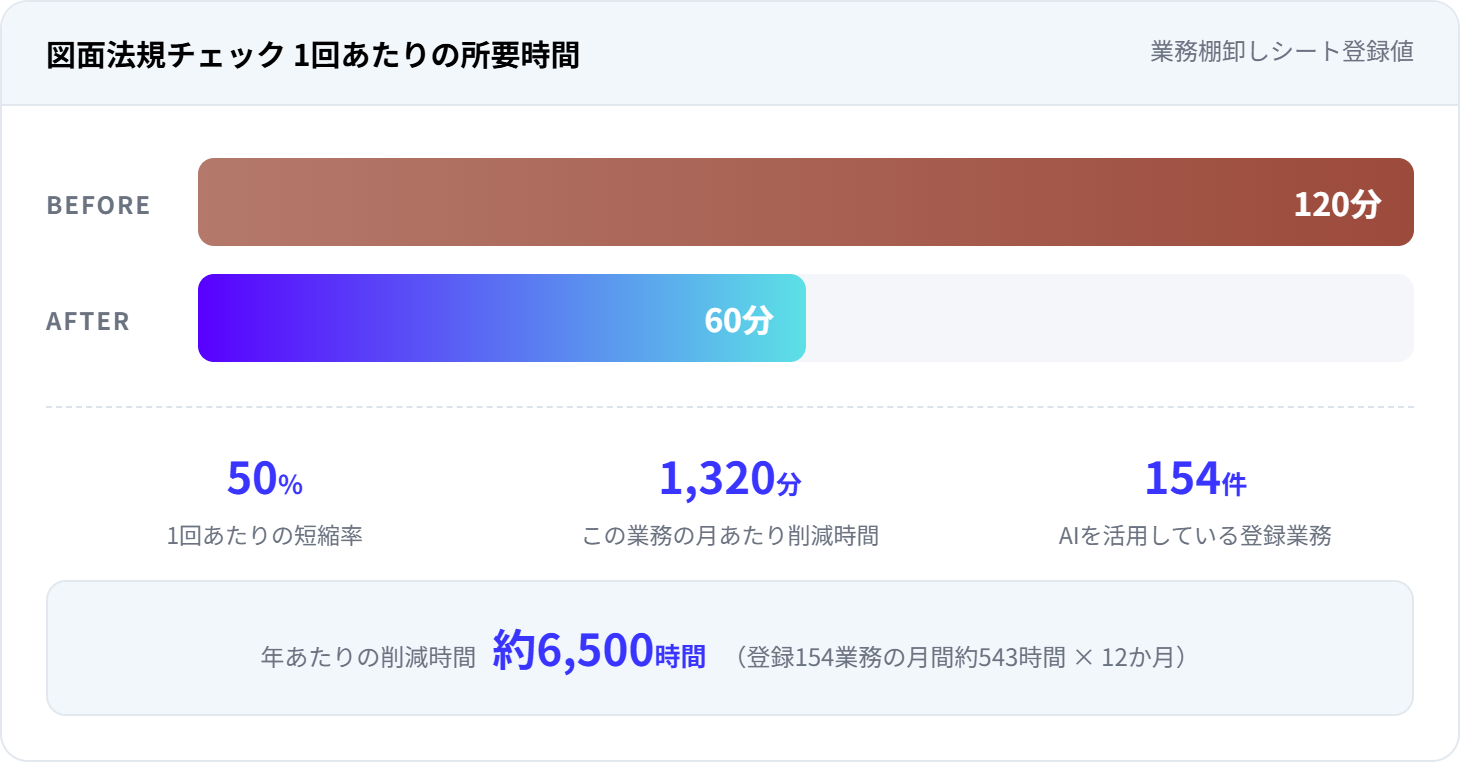
When we compiled data from 154 entries (30 people) that registered the use of AI in the business process inventory sheet, we found that tasks that previously took 81,773 minutes per month manually now take 49,176 minutes.32,596 minutes (approximately 543 hours) per month, or approximately 6,500 hours per year.This represents a reduction in workload. Approximately 40% of this reduction is accounted for by the 26 tasks of creating and reviewing emails.
The survey indicators have also shown improvement throughout the four surveys.
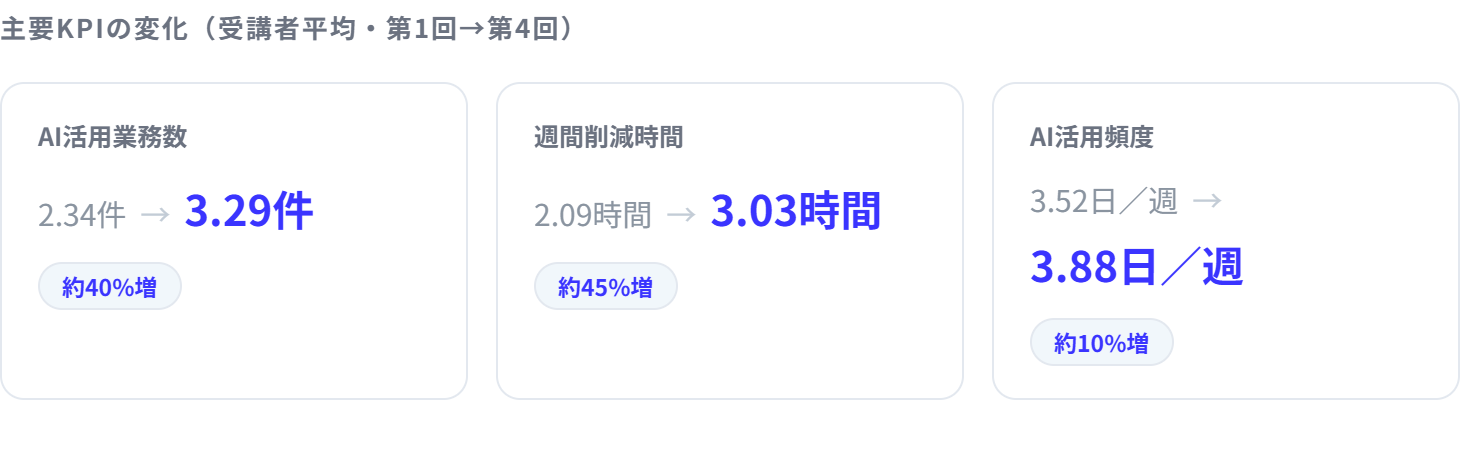
The frequency of use was high from the start, at around 3.5 days per week. What increased were the "number of tasks using AI" and the "actual time saved." Rather than an increase in the frequency of use, it can be said that the range of tasks to which AI can be applied expanded, and the effects of each individual application accumulated.
Before/After by Task (Top 5 Tasks with Reduced Time)
| business | Before | After | reduction/month |
|---|---|---|---|
| Compose emails (300 per week) | 5 minutes | 2 minutes | 3,600 minutes |
| Checking drawing regulations | 120 minutes | 60 minutes | 1,320 minutes |
| Creating emails (using Gems) | 120 minutes | 60 minutes | 1,200 minutes |
| Estimated construction costs | 180 minutes | 90 minutes | 1,170 minutes |
| Investigation of new construction methods | 120 minutes | 60 minutes | 1,020 minutes |
* Before/After shows the time required per session. Reduction/month is the monthly value calculated by multiplying the time by the frequency.
The top tasks included emails with a high volume of responses and specialized tasks that are time-consuming. Even if each email only takes 5 minutes to process, 300 emails a week would amount to 3,600 minutes a month. In specialized tasks, however, the use of AI to handle preliminary verification and organization, such as checking drawings for compliance and rough cost estimation, has become established. There were also 21 tasks using Gem and NotebookLM, and their applications are expanding to include checking contracts, verifying changes in the Tokyo Stock Exchange's regulations, and updating investor Q&A sites, where the AI answers questions based on company documents.

Looking at the flow of events over the course of a day, the changes are as follows:
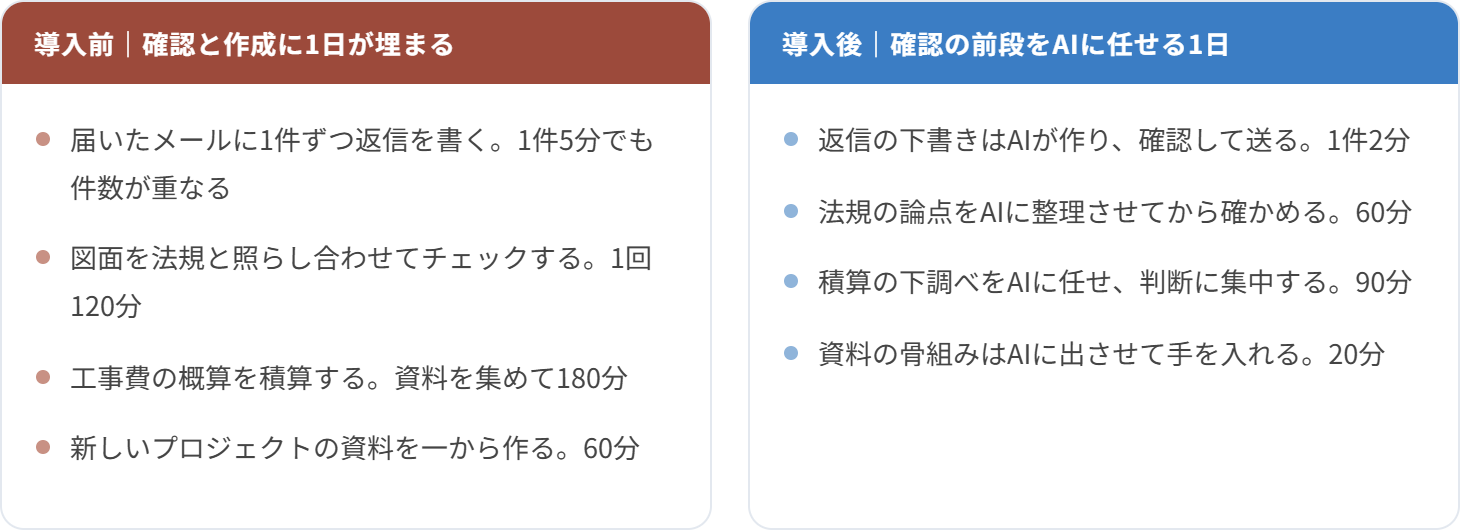
These changes are also reflected in the participants' feedback.

Some participants felt that the training not only speeded up their own work but also allowed them to share their expertise with others. As is typical for a company that has been keeping records in spreadsheets, some participants felt a sense of accomplishment from analyzing the data.

In the final episode, a new perspective emerged: the importance of using different tools effectively.

The participants progressed from the stage of improvising on their own to the stage of understanding the characteristics of the tools and applying them to their work. The satisfaction rating for the fourth session was the highest of all four sessions at 4.18, and the participants' sense of accomplishment accumulated throughout the training.
Future outlook
The next step is to transform the AI applications that have spread through training from individual ingenuity to organizational assets.
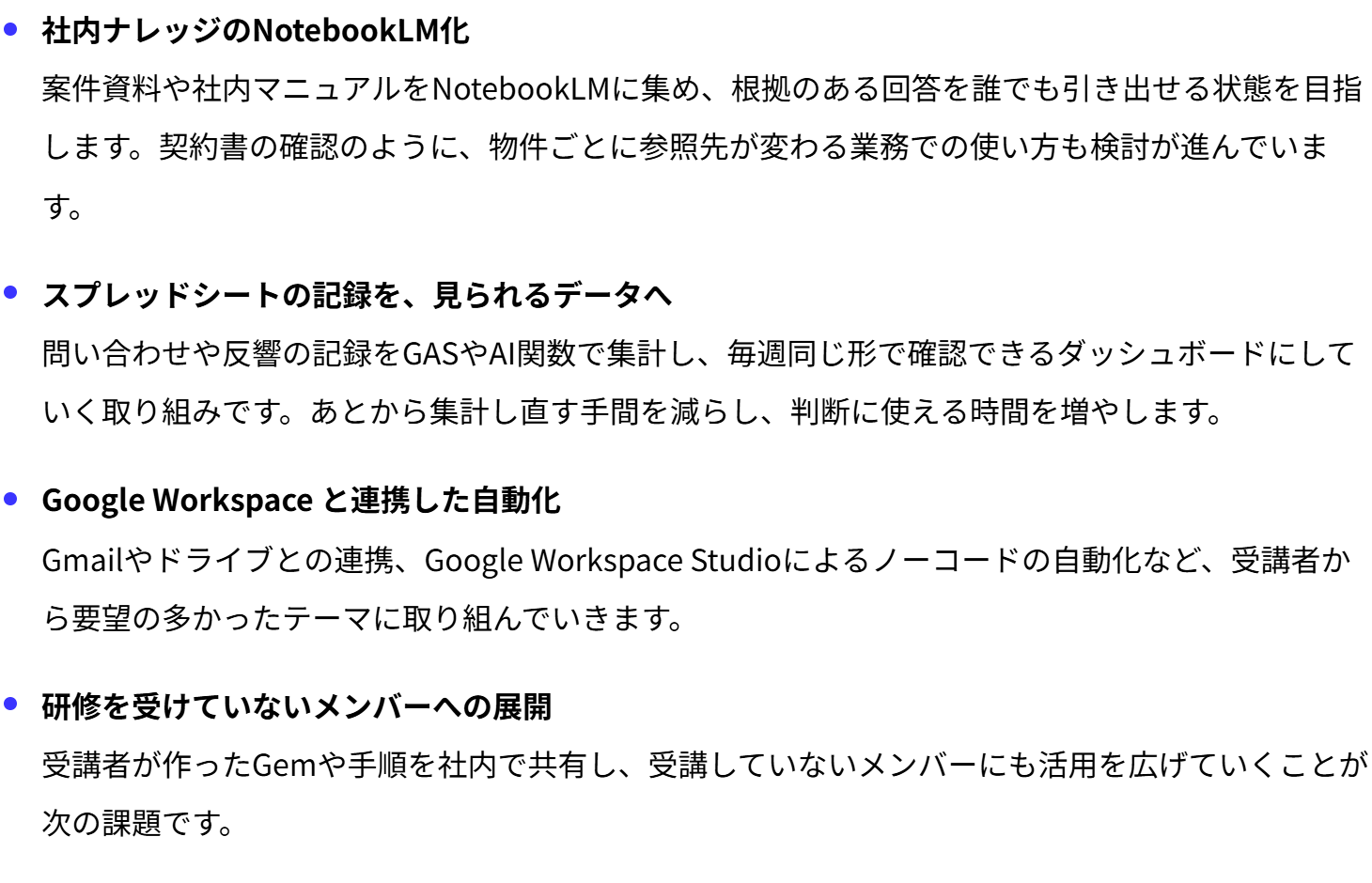
Having previously given new value to old buildings, the company has now focused on improving its own work processes. True to its philosophy of "adding value to the old, and creativity to real estate," it will leverage the knowledge gained from past projects with AI to accelerate the creation of cities and buildings that can be used for 100 years.